New Delhi, November 9 (News Desk): Delhi’s air quality deteriorated sharply after Diwali celebrations, with the national capital waking up to a thick blanket of smog on Monday as the Air Quality Index (AQI) entered the severe category at several monitoring stations.
The city’s average AQI stood at 370 at 9.05 am on November 9, according to data reported by The Indian Express, while eight monitoring stations recorded readings above 400, falling in the severe category.
Mundka recorded the highest AQI at 425, followed by Vivek Vihar at 421, North Campus at 419, Rohini at 417, Jahangirpuri at 415, ITO at 414, Punjabi Bagh at 410 and Patparganj at 409.
The pollution spike followed Diwali celebrations on Sunday, November 8, when firecracker emissions added to the city’s existing pollution burden.
Delhi records worst Diwali air quality since 2021
According to Central Pollution Control Board (CPCB) data cited by The Indian Express, Delhi’s average AQI touched 376 on Diwali day, higher than the corresponding readings recorded during the festival in each of the previous four years.
The average AQI was 345 in 2025, 328 in 2024, 218 in 2023 and 312 in 2022. The pollution levels rose sharply after sunset. The city-wide average PM2.5 concentration increased from around 117 micrograms per cubic metre at 5 pm on Sunday to 493.17 micrograms per cubic metre by 11 pm.
It climbed further to 584.2 micrograms per cubic metre at 1 am on Monday.
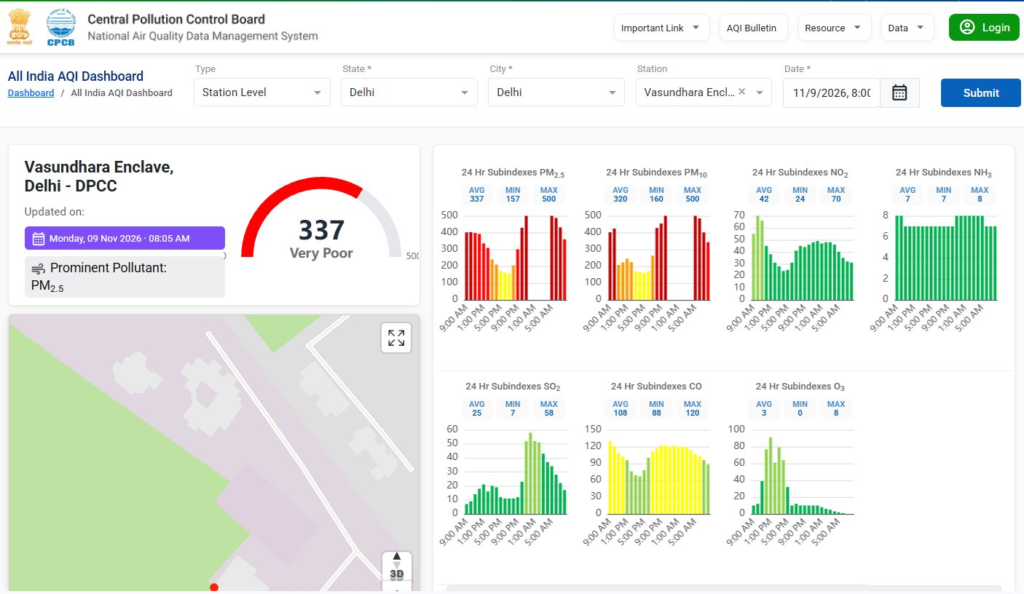
At North Campus, the hourly PM2.5 concentration peaked at 998.90 micrograms per cubic metre, while the Dr Karni Singh Shooting Range recorded 995 micrograms per cubic metre.
Why did Delhi’s air quality worsen after Diwali?
Firecracker emissions contributed to the sharp increase in particulate matter, particularly PM2.5 and PM10, during the evening and overnight hours. However, weather conditions also played a role in trapping pollutants close to the ground.
According to the India Meteorological Department (IMD), calm winds and dry weather conditions contributed to the persistence of smog over the capital.
ALSO READ: Rahul Gandhi Dharna: Delhi Police Files FIR After Pellet-Gun Row
At Safdarjung, visibility dropped to 50 metres by 6.30 am on Monday before improving later in the morning. Dense fog conditions were reported for several hours. Apart from firecrackers, vehicular emissions, construction-related dust and pollution transported from neighbouring regions remain part of Delhi’s wider air-quality challenge.
What is the forecast for Delhi’s air quality?
The Air Quality Early Warning System had forecast a deterioration in Delhi’s air quality to the severe category from November 9, with the possibility of such conditions persisting for the next few days.
Authorities and residents are likely to remain concerned about the health impact of prolonged exposure to elevated particulate matter levels. Under India’s AQI classification, readings between 301 and 400 fall in the very poor category, while readings between 401 and 500 are classified as severe.
The latest readings underline the recurring pollution challenge faced by Delhi during the post-Diwali period, when emissions, weather conditions and seasonal sources combine to affect air quality.